
USE CASES

Implementation Example • Insurance & Risk Transfer

Country Risk Pricing & Scenario Stress-Testing

How underwriting, actuarial, and risk analytics teams can use Talosai to strengthen country-risk pricing inputs, build measurable scenario triggers, and improve stress-testing by separating acute shocks from weakening structural resilience using continuously updated multi-source OSINT intelligence.
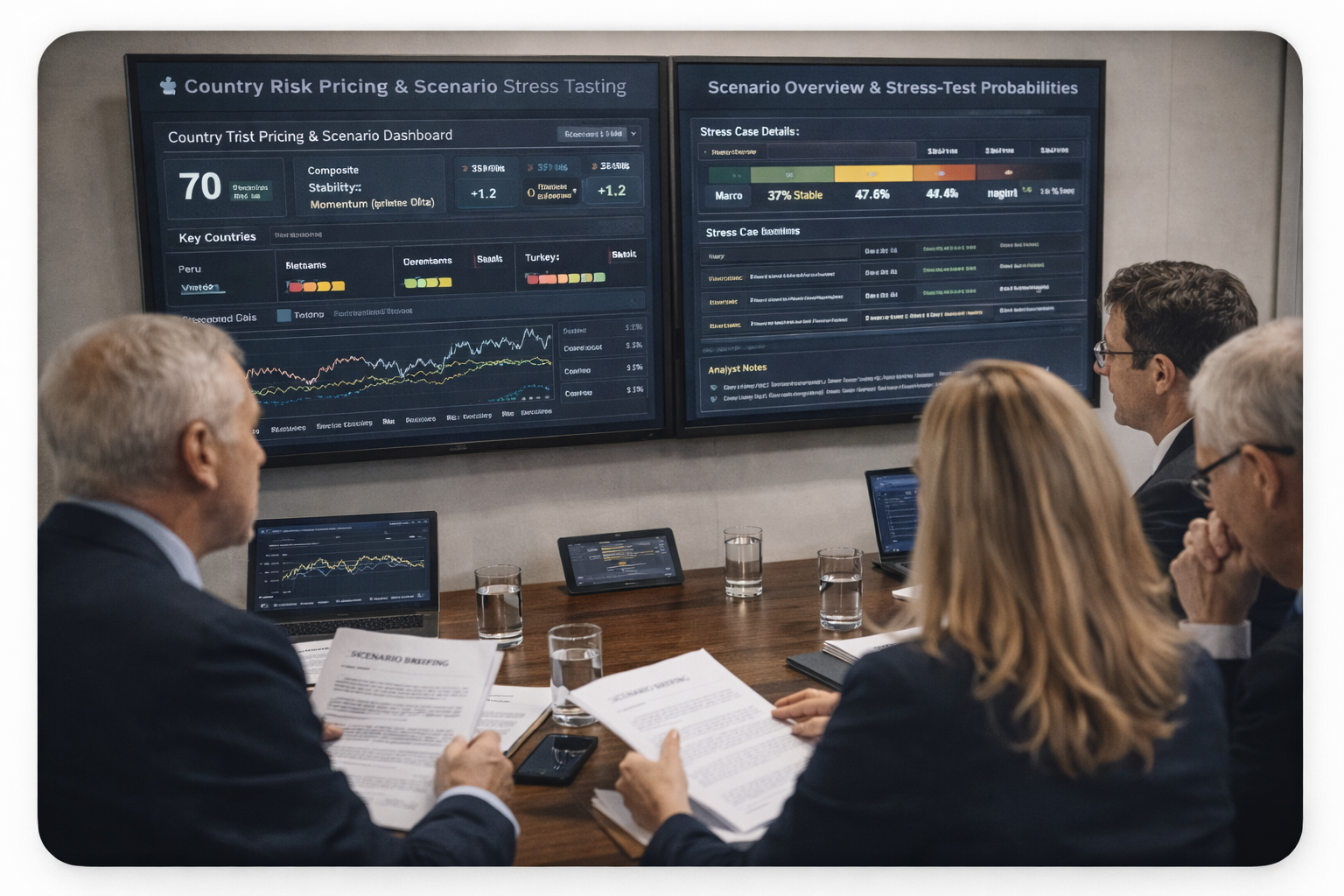
Talosai insurance and country risk pricing dashboard

From Static Pricing Assumptions to Dynamic Risk Signals

Talosai helps insurers and risk-transfer teams move beyond lagging country indicators by integrating OSINT narrative monitoring, public concern dynamics, forex signals, historical baselines, momentum, and evidence diagnostics into a continuously updated pricing and stress-testing framework.

At a Glance
Primary users
Underwriters, actuarial teams, risk analytics groups, and reinsurance stakeholders
Decision cadence
Monthly pricing reviews · Quarterly portfolio analysis · Event-driven adjustments
Primary signal streams
OSINT narrative monitoring · Public search dynamics · Forex/currency signals
Key analytical capabilities
Threshold monitoring · Momentum · Evidence diagnostics · Drivers of change · Outlook probabilities · Correlation & lead-lag analysis · Decision-grade contextual analysis

User Profile

Insurance & Risk Transfer Governance

Organization Type
Insurer or reinsurer with international exposure across political risk, trade credit, supply-chain interruption, specialty lines, and country-linked business interruption exposure.
Role & Mandate
Price country-linked exposure appropriately, validate accumulation risk, and stress-test deterioration pathways that reflect realistic operational and political dynamics.
Operating Constraints
Traditional pricing models often rely on lagging indicators and generic scenarios that fail to capture how instability develops through convergence, spillover, and weakening resilience.

Operational Context

When Country Conditions Begin to Affect Loss Exposure

An insurer can face growing exposure in countries where business volumes increase while governance pressure, labor unrest, localized violence, inflation stress, or regulatory volatility begin to intensify. These conditions may not immediately appear in traditional pricing inputs, but they can materially affect claims frequency, business interruption exposure, political risk accumulation, and reinsurance posture.

Portfolio objective
Improve pricing responsiveness and scenario credibility by using measurable country-risk trajectory, threshold probabilities, evidence diagnostics, and cross-source validation to support defensible underwriting and capital decisions.

Core Challenge

Translating Country Conditions Into Pricing & Scenario Inputs

Problem to solve
Convert evolving country conditions into pricing, accumulation, and stress-testing inputs with measurable triggers that distinguish short-term shocks from persistent deterioration and structural vulnerability.
Common failure modes
  • Pricing adjustments occur only after market repricing or loss experience.
  • Stress scenarios are generic and fail to reflect realistic deterioration pathways.
  • Overweighting a single indicator while ignoring cross-domain convergence.
  • Weak confidence framing that reduces committee and reinsurer acceptance.
  • Qualitative trigger definitions that create inconsistent execution.

Talosai in Practice

A Structured Workflow for Country-Risk Pricing & Stress Testing

Talosai helps underwriting and risk analytics teams establish a combined measurement and interpretation layer for country-risk governance. Dashboards provide measurable signals, while contextual analysis explains what is changing, why it matters, and what pricing, accumulation, and capital decisions it should inform.

Step 1
Establish Baseline Trajectory
Use historical baselines, trend movement, and monthly averages to determine whether a country is stable, deteriorating, or entering a mixed-risk posture relative to its own history.
Step 2
Use Thresholds as Pricing Gates
Apply Watch and Stress thresholds to composite and critical indicators so persistent deterioration triggers review of pricing loads, terms, limits, and accumulation exposure.
Step 3
Detect Short-Term Acceleration
Use momentum analysis to identify near-term deterioration before it becomes visible in slower-moving averages, supporting earlier underwriting adjustments during fast-moving periods.
Step 4
Require a Confidence Statement
Use evidence strength, reporting volume, and source breadth to distinguish high-confidence deterioration from weak or poorly supported signals.
Step 5
Differentiate Shock vs Structural Vulnerability
Use drivers-of-change analysis to separate acute stress events from weakening structural resilience, improving realism in loss pathways and long-duration deterioration scenarios.
Step 6
Control for Perception Risk
Compare domestic versus external narrative pressure to identify when reputational or external amplification risks may affect claims, counterparties, trade flows, or regulatory posture.
Step 7
Use Outlook Probabilities for Stress Tests
Use forecast ranges and threshold probabilities to calibrate scenario severity, likelihood, capital impact, and reinsurance planning across thirty-, sixty-, and ninety-day horizons.
Step 8
Refine Scenarios With Linkage Tools
Use correlation and lead-l