
USE CASES

Implementation Example • Security & Defense

Operational Risk for Personnel & Field Activity

How security operations teams can use Talosai to monitor escalation risk, validate confidence using evidence diagnostics, and establish measurable posture triggers for travel, staffing, and field activity using continuously updated multi-source OSINT intelligence.
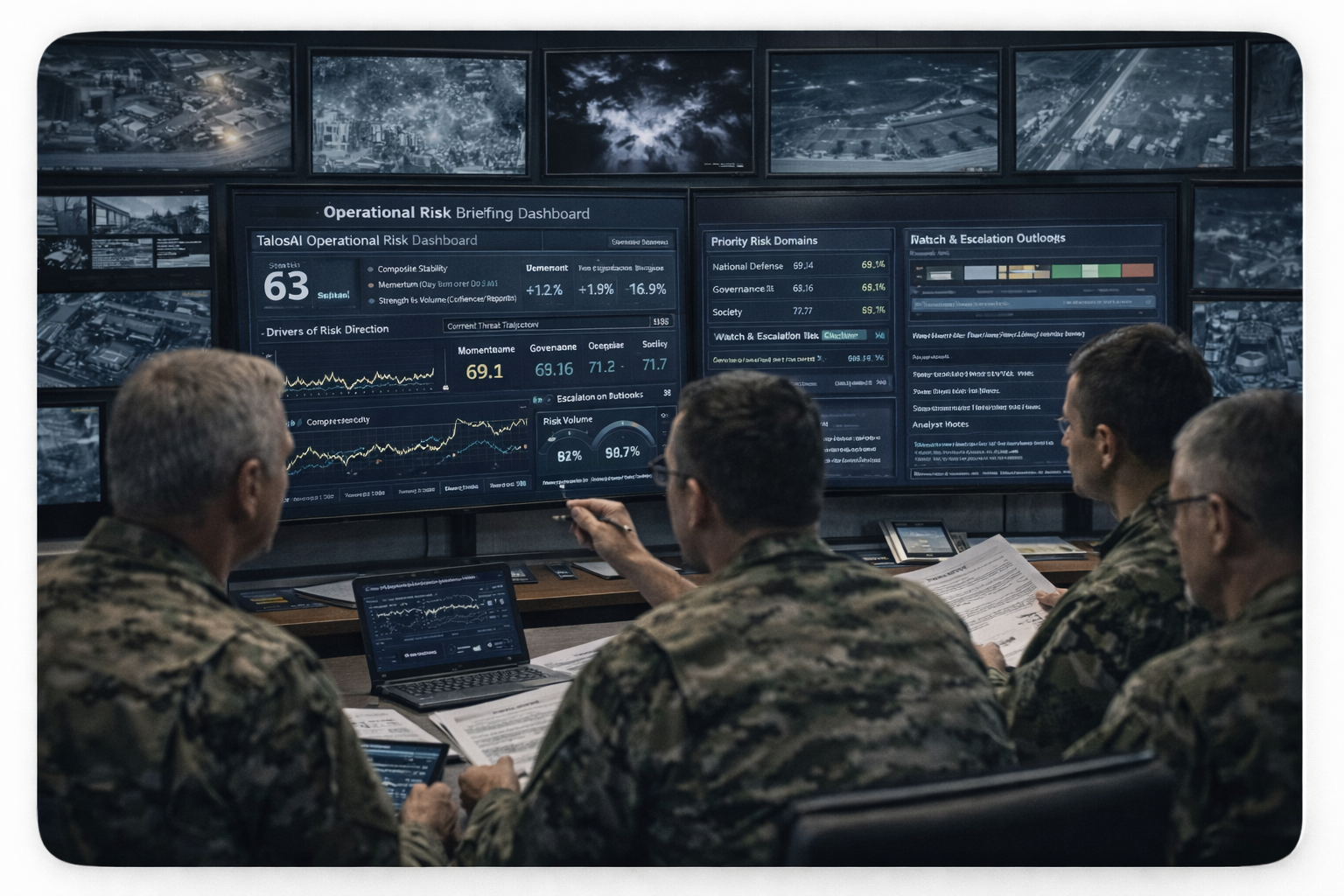
Talosai operational security and field risk dashboard

From Situational Awareness to Operational Posture Decisions

Talosai helps security and field operations teams move beyond reactive incident monitoring by integrating OSINT narrative pressure, public concern dynamics, historical baselines, momentum, evidence diagnostics, and forecast probabilities into a measurable operational risk framework.

At a Glance
Primary users
Security managers, duty officers, field operations leaders, and crisis-response teams
Decision cadence
Weekly monitoring · Rapid posture updates during escalation windows
Primary signal streams
OSINT narrative monitoring · Public search dynamics · Cross-domain risk indicators
Key analytical capabilities
Momentum · Threshold monitoring · Evidence diagnostics · Drivers of change · Narrative origin analysis · Outlook probabilities · Decision-grade contextual analysis

User Profile

Security & Field Operations Governance

Organization Type
Organizations with deployed personnel and field operations, including contractors, humanitarian missions, NGOs, corporate field teams, and international operations staff.
Role & Mandate
Protect personnel through measurable posture guidance, movement approvals, escalation monitoring, contingency planning, and evidence-based operational restrictions.
Operating Constraints
Rapidly evolving incidents, high noise from rumor and headline cycles, and the need to justify operational restrictions using measurable signals and defensible thresholds.

Operational Context

When Escalation Risk Becomes Operationally Relevant

This use case applies when an organization maintains a field presence in a country where conditions are generally manageable but periodically volatile. Over time, reporting may indicate increasing security incidents, growing public safety concerns, heightened tensions near transport routes, or weakening institutional control. The challenge is determining whether these signals represent isolated events, localized deterioration, or a broader escalation trend requiring posture adjustment.

Operational objective
Provide early warning and defensible posture guidance by translating public evidence into measurable operational risk signals, confidence checks, escalation triggers, and contingency decisions supported by contextual intelligence analysis.

Core Challenge

Acting Early Without Creating Operational Fatigue

Problem to solve
Determine whether escalation risk is becoming persistent, identify which indicators are driving deterioration, and apply movement restrictions or mitigation actions only when evidence and persistence justify the operational cost.
Common failure modes
  • Overreacting to isolated incidents that do not persist.
  • Underreacting to slow deterioration lacking a dramatic trigger.
  • Confusing external media attention with domestic escalation risk.
  • Weak confidence checks leading to false positives and disruption fatigue.
  • Operational restrictions not tied to explicit thresholds.

Talosai in Practice

A Structured Workflow for Operational Posture Decisions

Talosai provides a repeatable posture decision framework that combines continuous country-risk measurement with contextual interpretation. Security teams can monitor escalation indicators, validate confidence, distinguish isolated incidents from systemic deterioration, and convert measurable signals into operational decisions.

Step 1
Map Posture Criteria to Indicators
Prioritize National Defense for conflict dynamics, Society for public safety and protest activity, Governance for institutional control, and Composite indicators to determine whether deterioration is spreading systemically.
Step 2
Triage With Thresholds
Use Watch and Stress thresholds to identify posture candidates while requiring persistence, evidence checks, and driver analysis before triggering operational restrictions.
Step 3
Detect Near-Term Deterioration
Use momentum analysis to identify accelerating deterioration early enough to adjust travel protocols, staffing posture, communications requirements, and contingency planning.
Step 4
Validate Confidence
Require evidence strength, reporting volume, and source consistency before implementing major posture shifts, reducing false alarms and unnecessary operational disruption.
Step 5
Separate Escalation From Amplification
Compare domestic and external narrative pressure to determine whether deterioration is operationally meaningful on the ground or primarily an external attention cycle.
Step 6
Explain the Mechanism
Use drivers-of-change analysis to distinguish acute event pressure from weakening resilience, clarifying whether posture changes should be temporary or structural.
Step 7
Plan With Outlook Probabilities
Use forecast ranges and threshold probabilities to guide contingency activation timing, evacuation readiness, staffing posture, and pre-positioning decisions.

Mapped Dashboard Features

What the Team Used