
USE CASES

Implementation Example • Private Sector

Portfolio Exposure & Country Concentration Risk

How investment, insurance, banking, and enterprise risk teams can use Talosai to monitor portfolio exposure across countries, identify concentration risk, and detect early warning signals before localized instability becomes a material financial or operational threat.
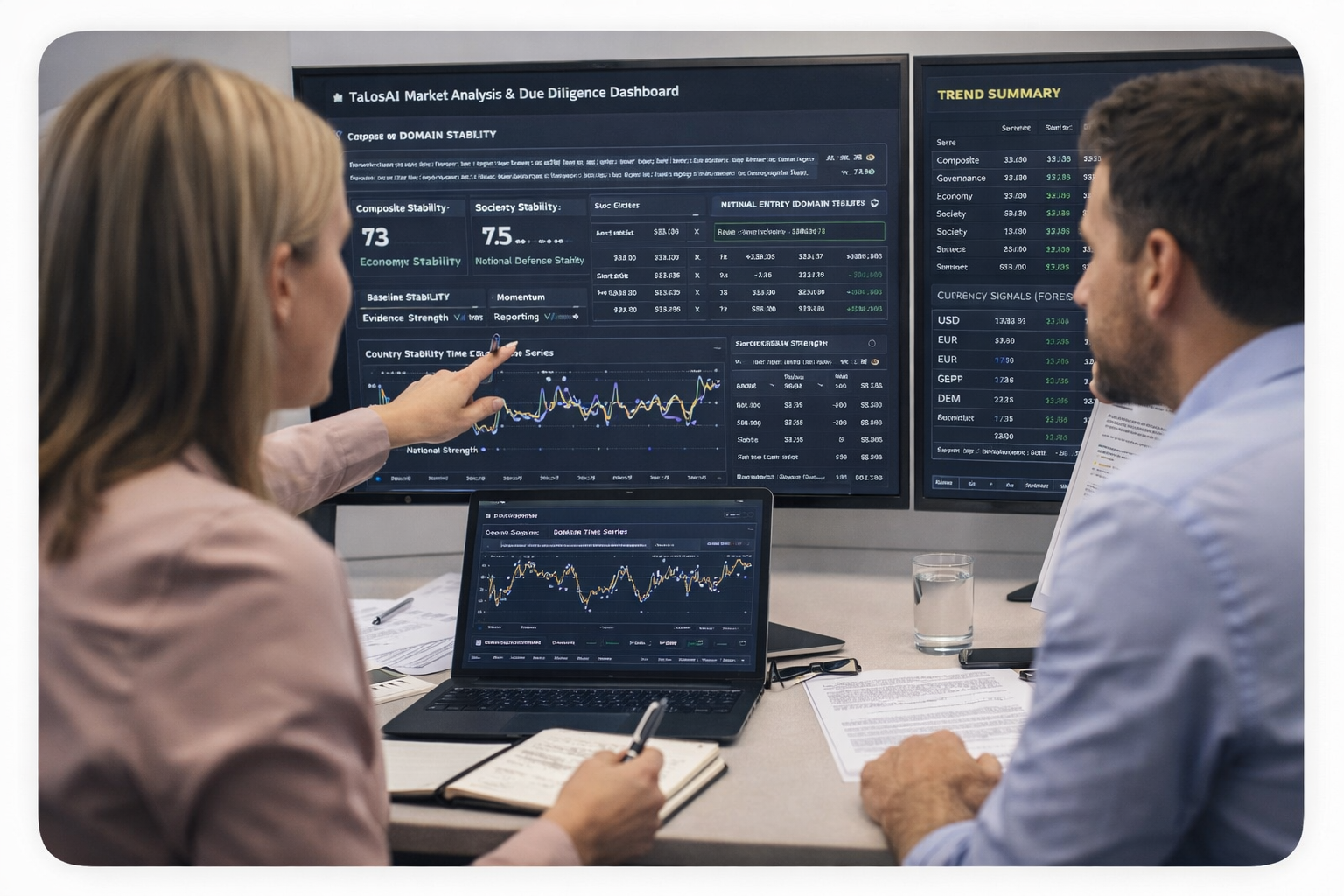
Talosai portfolio exposure and country concentration risk dashboard

From Country Exposure to Portfolio-Level Risk Awareness

Talosai helps teams move beyond static country ratings by continuously comparing OSINT narrative pressure, public search concern, currency signals, historical baselines, and forecast ranges across countries where capital, assets, vendors, insured exposure, or operations are concentrated.

At a Glance
Primary users
Portfolio managers, insurers, lenders, corporate risk teams, investment committees, and strategic planners
Decision cycle
Monthly portfolio review + weekly monitoring for high-exposure countries
Primary signal streams
OSINT narrative monitoring · Public search dynamics · Forex/currency signals
Key analytical features
Country risk baselines · Domain stress signals · Momentum · Evidence strength · Cross-source divergence · Currency pressure · Forecast ranges · Watch and stress thresholds
User Profile

Portfolio and Exposure Management

Organization Type
Financial institution, insurer, investor, multinational company, or enterprise risk team with exposure distributed across multiple countries.
Role & Mandate
Monitor where country-level risk is building, identify concentrated exposure, and support decisions on capital allocation, insurance limits, lending posture, vendor reliance, and operational contingency planning.
Operating Constraints
Exposure can accumulate quietly across countries, counterparties, assets, suppliers, and contracts before leadership has a clear view of whether the underlying country-risk environment is changing.
Operational Context

When Country Risk Becomes Portfolio Risk

A portfolio may appear diversified on paper while still carrying concentrated exposure to countries experiencing rising governance pressure, economic stress, social strain, currency volatility, or deteriorating public confidence. These conditions may not immediately appear in traditional ratings or quarterly reports, but they can materially affect credit exposure, insurance risk, supply chains, operating continuity, and asset valuation.

Exposure management requirement
The team needed a repeatable way to identify where country-level pressure was rising across the portfolio, separate isolated noise from supported risk signals, and define measurable watch lines for countries where exposure was financially or operationally material.
Core Challenge

Identifying Concentration Risk Before It Becomes Loss Exposure

Problem to solve
Determine which countries in the portfolio were moving toward higher risk, whether the movement was supported by multiple evidence streams, and whether exposure levels justified mitigation, closer monitoring, or changes to portfolio posture.
Common failure modes
  • Viewing countries individually instead of as part of a concentrated exposure map.
  • Relying on lagging country ratings after risk has already repriced.
  • Missing public concern or narrative pressure before financial indicators react.
  • Confusing short-term news spikes with durable deterioration.
  • Failing to connect country-level risk to portfolio-level financial impact.
Talosai in Practice

A Structured Workflow for Portfolio Exposure Decisions

Talosai helps teams compare country risk across an exposure universe by combining historical context, current stress signals, source strength, public concern, financial indicators, and forecast ranges into a decision-ready monitoring framework.

Step 1
Map Exposure to Countries
Identify where capital, insured exposure, counterparties, suppliers, assets, or operations are concentrated, then prioritize countries where exposure is financially or operationally material.
Step 2
Establish Country Risk Baselines
Review structural context, historical baselines, and current stress levels to determine whether each country is operating within normal bounds or showing abnormal pressure.
Step 3
Identify Domain-Level Drivers
Compare Governance, Economy, Society, National Defense, Health, and Psychological Strain to identify which domains are driving elevated country risk.
Step 4
Check Signal Strength
Use evidence strength, reporting volume, source coverage, and recency to determine whether observed risk movement is well-supported or should be treated with caution.
Step 5
Triangulate Across Sources
Compare OSINT narrative pressure, public search interest, and currency movement to identify whether risk signals are reinforcing each other or diverging.
Step 6
Set Portfolio Watch Lines
Convert country indicators into thresholds for exposure review, underwriting caution, lending limits, supplier diversification, hedging, or contingency planning.
Mapped Dashboard Features

What the Team Used

Current Risk Picture
Current stress level, domain drivers, and structural risk context.
Evidence Quality
Reporting volume, source breadth, recency, and data gaps.
Narrative & Search Signals
Domestic/external narrative origin, public concern momentum, and issue correlations.
Currency & Cross-Source Alignment
Forex movement, signal divergence, reinforcing indicators, and forecast ranges.
Decision Impact

What Changes in the Portfolio Decision?

Decision improvements
  • Identify where exposure is concentrated in countries with rising risk pressure.
  • Separate temporary volatility from supported multi-source deterioration.
  • Align investment, insurance, credit, and operational teams around one evidence-backed risk picture.
  • Define measurable watch lines before risk becomes financially material.
  • Prioritize mitigation resources toward the countries and domains driving the most exposure.
Outcome example
Leadership can move from broad concern about international exposure to a prioritized country watchlist, with defined thresholds for portfolio review, hedging, supplier diversification, underwriting caution, or capital reallocation when country-level risk signals strengthen.
Key Takeaway
Talosai Turns Country Exposure into a Monitorable Portfolio Risk Signal
By combining OSINT narrative monitoring, public search behavior, forex/currency signals, historical baselines, evidence strength, and cross-source alignment, Talosai helps organizations identify where country concentration risk is building and define practical triggers before exposure becomes a financial, operational, or strategic surprise.