
USE CASES
Country Risk Pricing & Scenario Stress-Testing
How an underwriting and risk analytics team can use Talosai to strengthen country risk pricing inputs, design scenario triggers tied to measurable thresholds, and improve stress testing by separating acute shocks from weakening resilience. Talosai combines near real-time country stability dashboards with decision-grade, contextual analysis, delivering intelligence that explains not just what is changing, but why it matters and what decisions it informs.
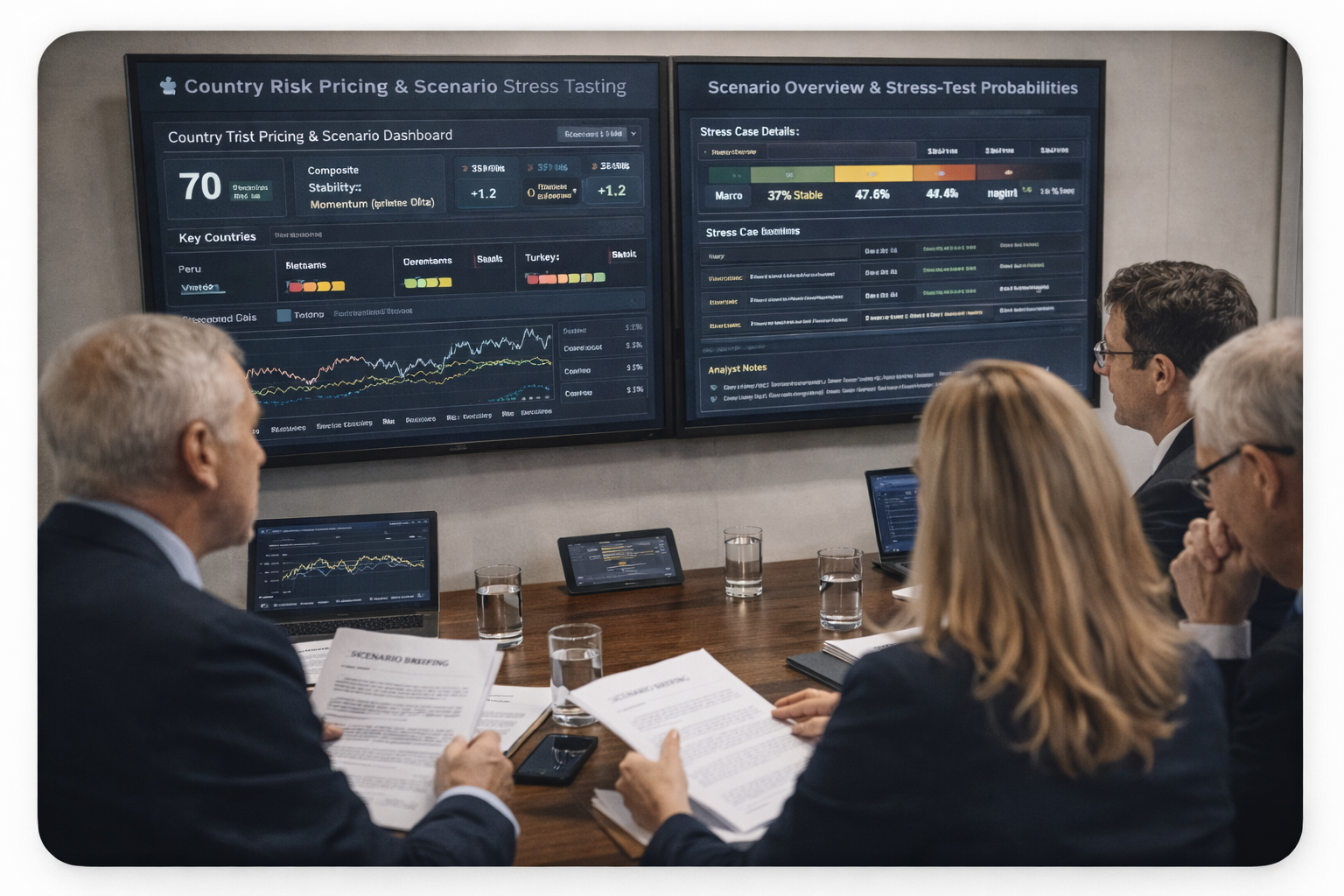
Watch and Stress thresholds, including persistence tracking
Stability Trend (MA14) and Monthly Average Levels
Momentum (MA7 vs MA14)
Evidence Strength and Reporting Volume diagnostics
Drivers of Change (Stress vs Resilience)
Domestic vs External lens, External Coverage Share, Tone Gap
Outlook ranges and threshold probabilities (30, 60, 90 days)
Correlation and lead-lag screening tools (where available)
Decision-grade, contextual analysis that explains what is changing, why it matters, and what decisions it informs
User Profile
Context
An insurer can face growing exposure in countries where business volumes increase while narrative conditions become less stable. Underwriters can observe more frequent signals related to governance controversy, labor unrest, localized violence, and inflation-driven stress. In this setting, a portfolio team can use Talosai to continuously measure stability trajectory across indicators, then use the accompanying decision-grade, contextual analysis to explain what is changing, why it matters, and what decisions it should inform for pricing, terms, and capital posture.
Challenge
- Pricing does not adjust until after loss experience or market repricing
- Scenarios are generic, so they miss the actual pathway of deterioration
- Overweighting a single indicator while ignoring cross-indicator convergence
- Unclear confidence, which weakens committee and reinsurer acceptance
- Trigger definitions that are qualitative, making execution inconsistent
Talosai in Practice
An underwriting and risk analytics team can integrate Talosai into country risk governance as a combined measurement and interpretation layer. The dashboards can provide consistent signals for stability trajectory, near-term acceleration, evidence support, and planning probabilities. The accompanying decision-grade, contextual analysis can interpret what the signals mean for loss pathways, accumulation risk, policy terms, and portfolio posture, explaining what is changing, why it matters, and what decisions it should inform. These combined outputs can then be translated into pricing adjustments, scenario triggers, and monitoring requirements for high-exposure countries.
Decision Impact
- Pricing updates can become more timely because they are tied to measurable trajectory and thresholds
- Stress tests can improve because scenarios reflect realistic deterioration mechanisms, not generic shocks
- Committee discussions can improve with explicit confidence statements supported by evidence diagnostics
- Trigger definitions can become consistent across underwriters, risk, and reinsurance partners
Key Takeaway
By pairing continuously updated dashboards with decision-grade, contextual analysis, underwriting and stress testing can be anchored to trajectory, thresholds, evidence strength, and drivers, helping insurers price more consistently, stress test more realistically, and act earlier when risk is forming.