USE CASES

Case Study • Public Health

Health System Strain & Outbreak Readiness

How a public health operations team can use Talosai to detect early strain signals, validate confidence using evidence diagnostics, and trigger readiness actions aligned to thresholds and near term probabilities. Talosai combines near real-time country stability dashboards with decision-grade, contextual analysis, delivering intelligence that explains not just what is changing, but why it matters and what decisions it informs.
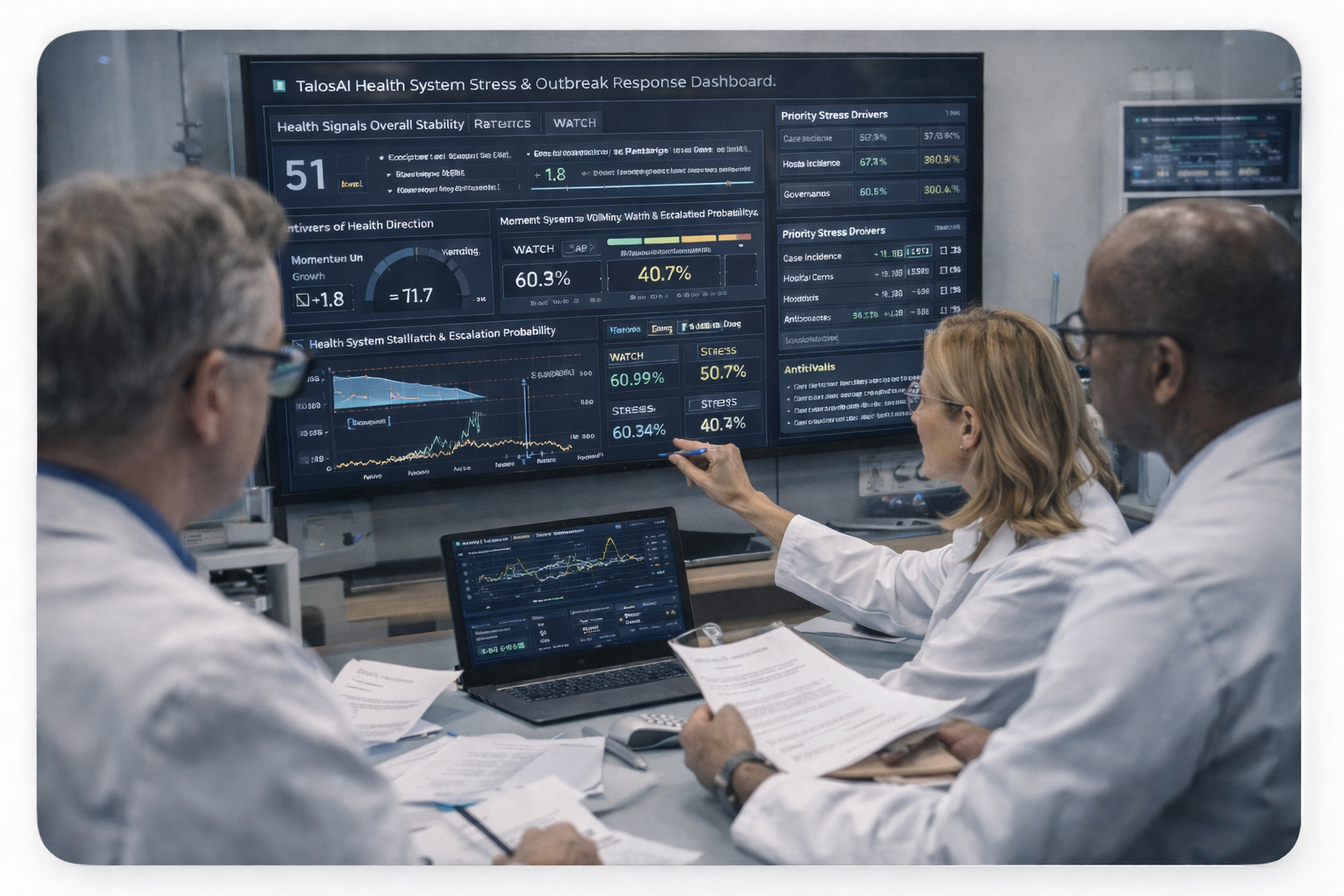
Talosai analysts reviewing stability and risk intelligence dashboards and contextual analysis

At a glance
Primary users
Public health agencies, NGOs, and health emergency operations teams
Decision cycle
Weekly readiness review, rapid escalation during outbreaks
Key Talosai features used
Health stability (system capacity, outbreak narratives, response effectiveness)
Governance stability (policy credibility, institutional trust, compliance narratives)
Society stability (community stress, access constraints, public safety)
Composite stability (system context)
Momentum (MA7 vs MA14)
Watch and Stress thresholds
Evidence Strength and Reporting Volume diagnostics
Domestic vs External lens, External Coverage Share, Tone Gap
Drivers of Change (Stress vs Resilience)
Outlook ranges and threshold probabilities (30, 60, 90 days)
Decision-grade, contextual analysis (why signals matter, what decisions they inform)

User Profile

Organization Type
Public health institution coordinating surveillance, preparedness, and response across clinical sites, local partners, and emergency management stakeholders.
Role & Mandate
Anticipate health system strain, identify escalation risk early, and trigger operational readiness actions such as staffing, supply pre positioning, and partner coordination, guided by measurable signals and decision-grade contextual interpretation.
Operating Constraints
Limited resources, high uncertainty, and a need to avoid both false alarms and delayed reaction when outbreaks or capacity shocks emerge, especially when signal quality varies across sources.

Context

This use case can apply when a team monitors a country where seasonal disease burden and periodic capacity constraints are common. In recent weeks, public reporting can suggest increasing hospital occupancy, supply shortages, and rising concern about a potential outbreak cluster. At the same time, public trust in health messaging can be uneven, and policy communication can face credibility challenges. External coverage can increase after regional spillover concerns emerge. Leaders can use Talosai to determine whether these signals represent transient noise, localized strain, or an emerging systemic health stress event, then translate that assessment into readiness decisions that are measurable, defensible, and aligned to clear thresholds.

Readiness objective
Identify early warning signals of health system strain, quantify confidence using evidence support, and set thresholds that trigger concrete readiness actions before capacity is exceeded. The goal is decision utility, pairing continuous measurement with decision-grade contextual analysis that explains what is changing, why it matters, and what actions it informs.

Challenge

Problem to solve
Determine whether health strain signals are persistent and escalating, identify whether governance and social conditions are weakening the response environment, and trigger readiness actions only when confidence and trajectory justify the cost. The intent is to move from descriptive monitoring to anticipatory planning.
Common failure modes
  • Overreacting to isolated outbreak headlines without persistence
  • Missing early capacity deterioration because signals are dispersed across sources
  • Inadequate confidence checks when coverage is thin or inconsistent
  • Planning without accounting for governance trust and compliance constraints
  • Readiness actions that lack explicit triggers, causing late escalation

Talosai in Practice

A public health operations team can use Talosai to formalize a weekly readiness workflow that pairs continuously updated dashboards with written, decision-grade contextual analysis. Health signals can be interpreted alongside Governance and Society signals to assess whether the response environment is strengthening or weakening. Evidence diagnostics and thresholds can convert narrative reporting into action triggers for staffing, supplies, and partner coordination, while the contextual analysis clarifies why signals matter and which readiness decisions are most exposed.

Step 1
Treat Health as an Operational Signal, Not a News Topic
Prioritize Health stability as a proxy for system strain and response capacity narratives, and track it against Watch and Stress thresholds to define when staged readiness actions should activate. Use contextual analysis to connect changes to practical choices about staffing, supplies, and surge posture.
Step 2
Assess Response Environment Constraints
Monitor Governance stability for institutional trust and policy credibility, and Society stability for community stress and access constraints. Weakening Governance or Society signals can indicate increased risk of compliance gaps and slower response effectiveness, informing how readiness actions should be designed and communicated.
Step 3
Detect Near Term Deterioration
Use Momentum (MA7 vs MA14) to identify early deterioration before it appears in slower moving averages. Sustained negative momentum can justify pre positioning actions even if the baseline remains above Watch, particularly when contextual analysis indicates convergence across Health, Governance, and Society.
Step 4
Validate Confidence With Evidence
Require Evidence Strength and Reporting Volume checks to confirm persistence. When evidence is low, treat sharp moves cautiously and triangulate signals across Health, Governance, and Society, then use contextual analysis to communicate uncertainty without delaying necessary preparatory steps.
Step 5
Separate External Attention From Domestic Strain
Use the Domestic vs External lens, External Coverage Share, and Tone Gap to determine whether external amplification is driving attention. This can reduce overreaction to global coverage spikes that are not matched by domestic strain signals, while still informing stakeholder communications and partner alignment.
Step 6
Explain Mechanism With Drivers
Use Drivers of Change (Stress vs Resilience) to determine whether deterioration is driven by acute pressure, weakening buffers, or both. This can shape whether readiness actions focus on surge capacity, longer term resilience support, risk communications, or all three, supported by a clear explanation of what is driving the signal.
Step 7
Plan With Outlook Probabilities
Use Outlook ranges and threshold probabilities to estimate the likelihood of Watch or Stress conditions in the next thirty to ninety days. Link probability bands to staged actions, including staffing calls, supply staging, partner coordination, and surge triggers, reinforced by contextual analysis that clarifies what decisions are most time-sensitive.
Mapped dashboard features
Health stability (system strain signals) · Governance and Society (response environment constraints) · Composite stability (system context) · Momentum (MA7 vs MA14) (early warning) · Watch and Stress thresholds (action triggers) · Evidence Strength and Reporting Volume (confidence) · Domestic vs External lens tools (attention attribution) · Drivers (Stress vs Resilience) (mechanism) · Outlook ranges and threshold probabilities (planning posture) · Decision-grade contextual analysis (meaning, implications, decision linkage)

Decision Impact

What can change in the decision
  • Readiness actions can become staged and measurable, tied to thresholds and momentum
  • False alarms can decrease when evidence strength is required for escalation
  • Resource allocation can improve by linking actions to Governance and Society constraints
  • Leadership communication can improve by separating external attention from domestic strain, supported by contextual explanation
Outcome (illustrative)
A team can implement a staged preparedness posture: increased monitoring when Health momentum turns negative with strong evidence, supply pre positioning when Health approaches Watch and Governance weakens simultaneously, and surge planning activation when outlook probabilities indicate elevated Stress risk. Response lead time can increase and limited resources can be used more efficiently because actions are tied to measurable signals, reinforced by decision-grade contextual analysis that clarifies implications for staffing, supplies, and partner operations.

Key Takeaway


Talosai helps public health teams convert public, web-published evidence into early warning and readiness triggers, supported by decision-grade contextual analysis that explains what is changing, why it matters, and what decisions it informs.

By combining Health strain signals with Governance and Society context, and by validating confidence using evidence diagnostics, persistence checks, and outlook probabilities, teams can act earlier, avoid false escalations, and protect system capacity when outbreaks emerge. This approach is designed to move beyond static snapshots toward continuously updated measurement and interpretable intelligence for real operational decisions.