USE CASES
Operational Risk for Personnel & Field Activity
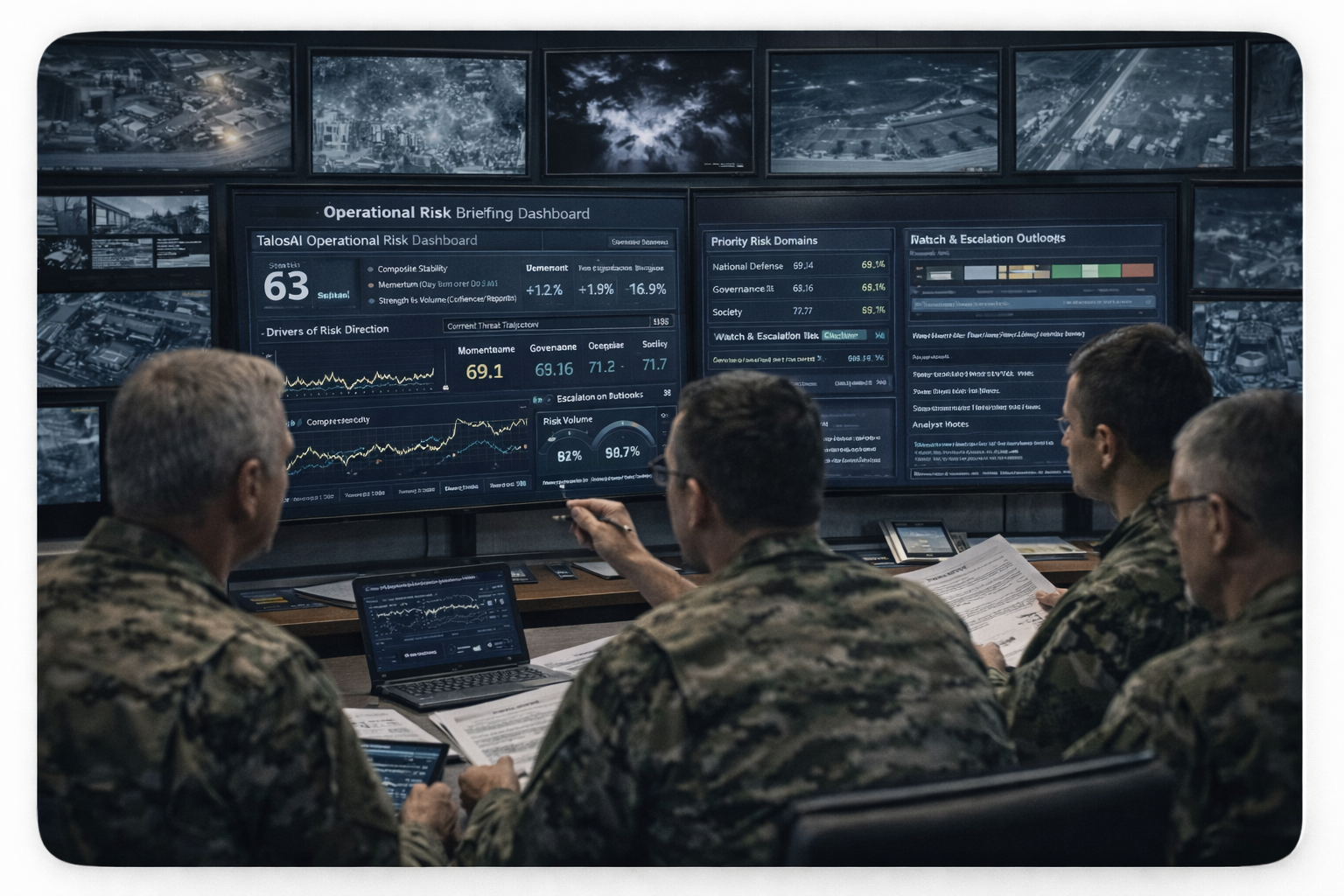
How a security operations team can use Talosai to monitor escalation risk, validate confidence using evidence diagnostics, and set posture triggers for travel, staffing, and field movements tied to measurable thresholds. Talosai combines near real-time country stability dashboards with decision-grade, contextual analysis, helping teams understand not just what is changing, but why it matters and what decisions it informs.
Society stability (crime, protests, public safety signals)
Governance stability (legitimacy, rule of law, institutional trust)
Composite stability (system context)
Momentum (MA7 vs MA14)
Watch and Stress thresholds
Evidence Strength and Reporting Volume diagnostics
Domestic vs External lens, External Coverage Share, Tone Gap
Drivers of Change (Stress vs Resilience)
Outlook ranges and threshold probabilities (30, 60, 90 days)
Decision-grade, contextual analysis (why signals matter, what decisions they inform)
User Profile
Context
This use case can apply when an organization maintains a field presence in a country where conditions are generally manageable but periodically volatile. Over several weeks, reporting may suggest an increase in security incidents, heightened tensions near key routes, and public safety concerns in urban areas. External attention can surge after a high visibility event, while local reporting can emphasize day to day operational constraints. The security team can use Talosai to determine whether escalation risk is becoming persistent, whether conditions are localized or systemic, and how to set movement posture in a way that is defensible, proportional, and aligned to explicit thresholds.
Challenge
- Overreacting to single incident headlines that do not persist
- Underreacting to slow deterioration because it lacks a dramatic trigger
- Confusing external attention surges with domestic escalation on the ground
- Insufficient confidence checks, leading to false positives and disruption fatigue
- Posture decisions not tied to explicit thresholds, so execution is inconsistent
Talosai in Practice
A security operations team can use Talosai as a repeatable posture decision framework that pairs continuous measurement with written, decision-grade contextual analysis. National Defense and Society can be treated as primary signals for field risk, Governance and Composite can be used to detect whether the environment is becoming systemically less controllable, and evidence diagnostics can be used to calibrate confidence before restricting movement. The accompanying contextual analysis can interpret the mechanism behind shifts, clarify whether pressures are isolated or converging, and translate dashboard evidence into decisions that are usable, not just observable.
Decision Impact
- Posture decisions can become measurable, consistent, and defensible
- Movement restrictions can be applied earlier when momentum and thresholds signal persistence
- False alarms can decrease when evidence strength is required for major posture shifts
- Leadership communication can improve by separating external pressure from domestic escalation, supported by contextual explanation of what is driving the shift
Key Takeaway
Talosai helps security teams convert public evidence into operational posture decisions that are measurable and defensible, supported by decision-grade contextual analysis that explains what is changing, why it matters, and what decisions it informs.
By combining indicator-specific stability signals, momentum, thresholds, evidence diagnostics, and planning probabilities, teams can reduce surprise, avoid overreaction, and protect personnel with clear triggers and credible confidence checks. This approach is designed for decision-makers who need trajectory and implications, not static snapshots or after-the-fact summaries.