
From Snapshots to Signals: Measuring & Analyzing Risk as It Evolves

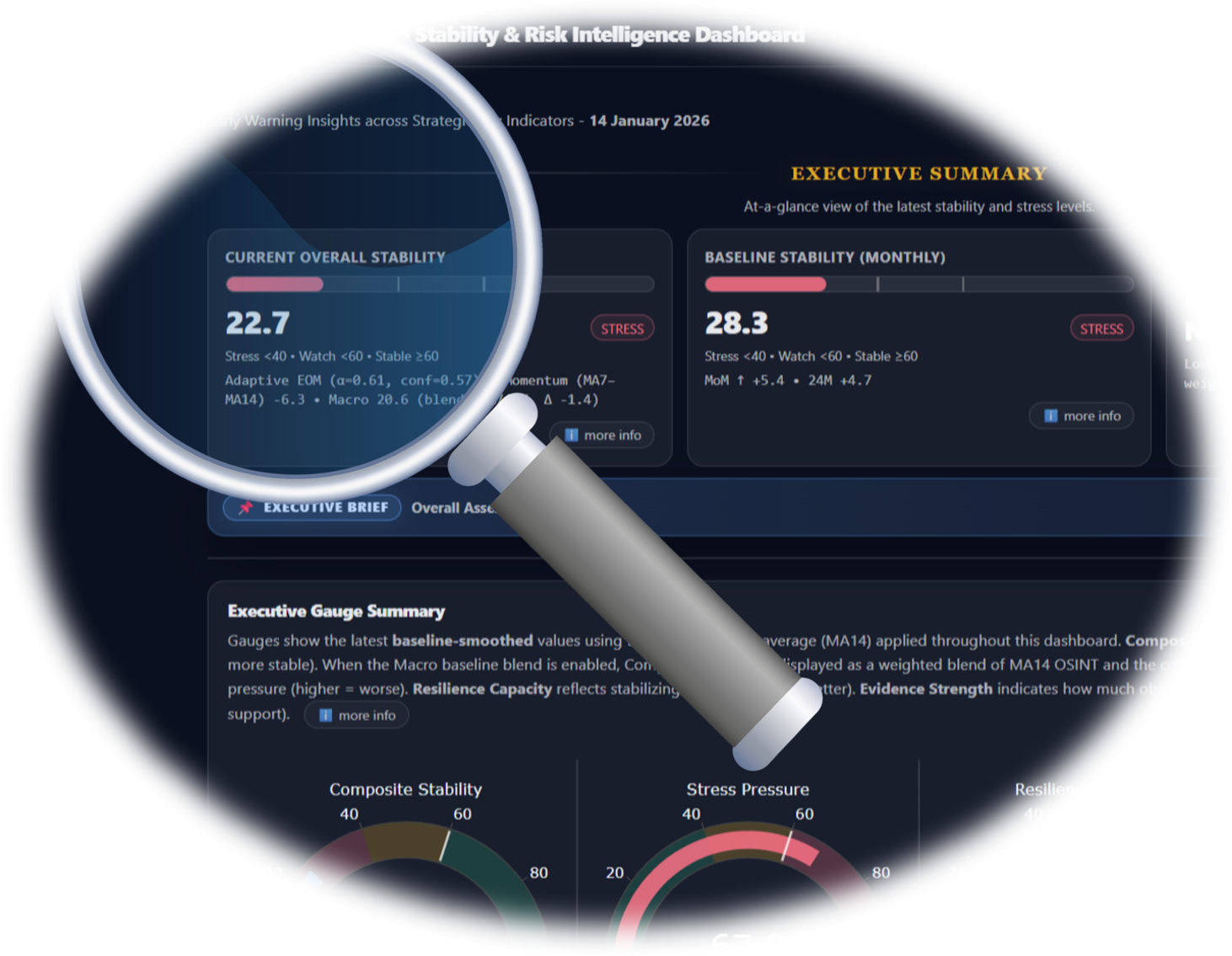
TalosAI dashboard preview

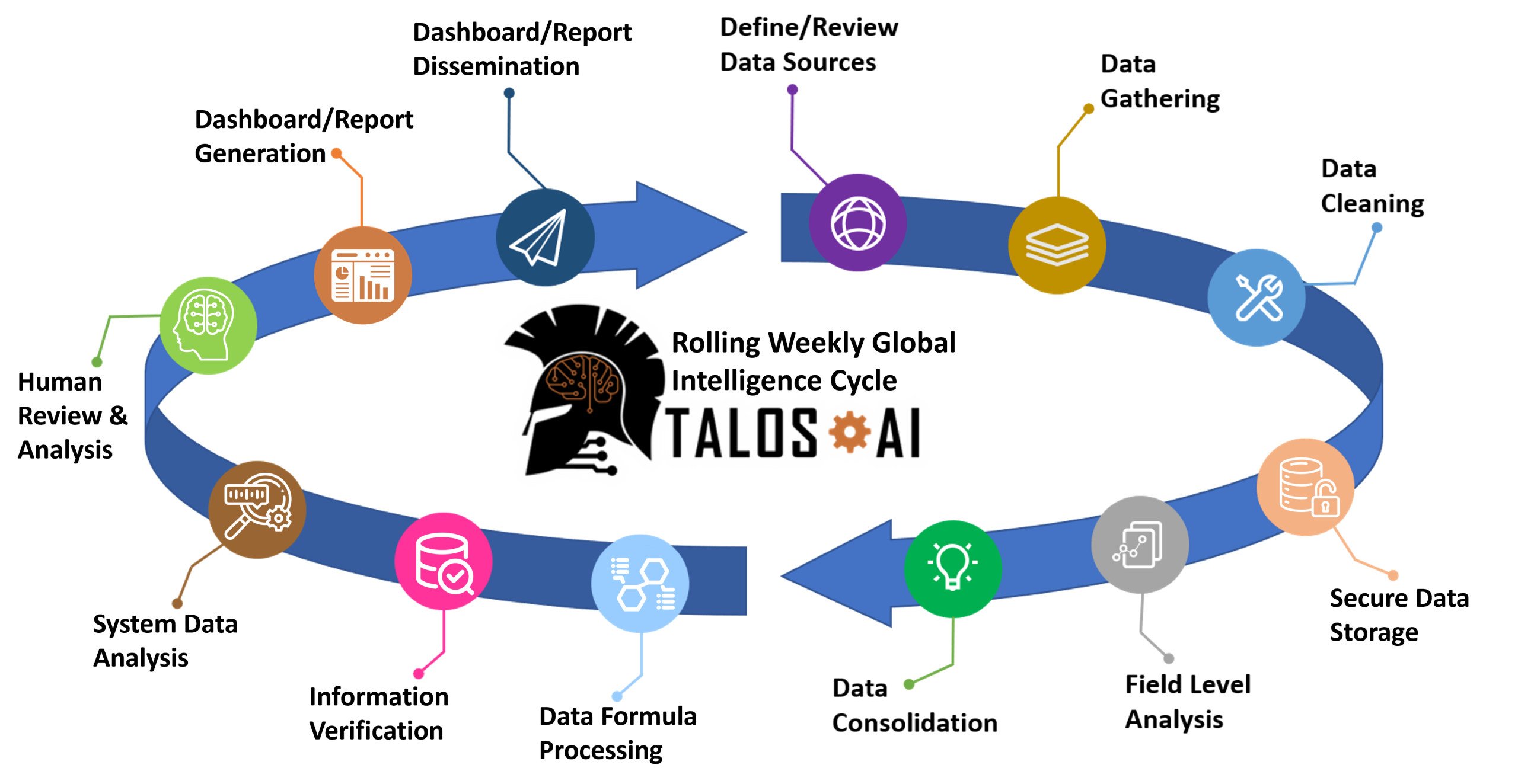
TalosAI continuously measures country stability and emerging risk by tracking changes in real-world signals across six core domains: Governance, Economy, Society, National Defense, Health, and Psychological Strain.

Rather than relying on static indices or backward-looking assessments, TalosAI analyzes how indicator volumes, sentiment balance, external attention, and signal gaps are changing week-to-week. These inputs are normalized, weighted, and recomputed to reveal direction (where conditions are moving), momentum (how fast they are changing), and convergence (whether pressures across domains are reinforcing each other).

The result is a near real-time measurement of how instability is forming, not just where it has already occurred. Each country view pairs these quantitative stability signals with decision-grade contextual analysis and direct access to the underlying indicator data—allowing users to see what is changing, what is driving it, why it matters, and which decisions it informs.

null

Policy Makers

Identify emerging instability and pressure points through continuously updated dashboards, supported by downloadable indicator data and contextual analysis, before crises emerge.
null

Business Leaders

Monitor country exposure dynamically using interactive dashboards, direct access to stability data, and decision-grade analysis that clarifies risk trajectories before they materialize.
null

Researchers

Analyze stability as a time-series system using longitudinal, normalized datasets available for download, paired with interpretive analytical insight.
null

Intelligence Community

Track signal persistence, convergence, and momentum across domains using interactive dashboards, formulaic data access, and contextual intelligence reporting.

From Continuous Monitoring to Decision-Ready Intelligence

Inputs are normalized, dynamically reweighted, and recomputed weekly to generate updated indicator scores, composite stability measures, trajectory signals, and threshold probabilities.
These outputs are delivered through interactive dashboards, downloadable formulaic datasets, and written decision-grade analysis that explains implications, confidence, and decision relevance.
Real-Time Deep Dive Analysis

Real-Time Analytical Depth for Anticipatory Decisions
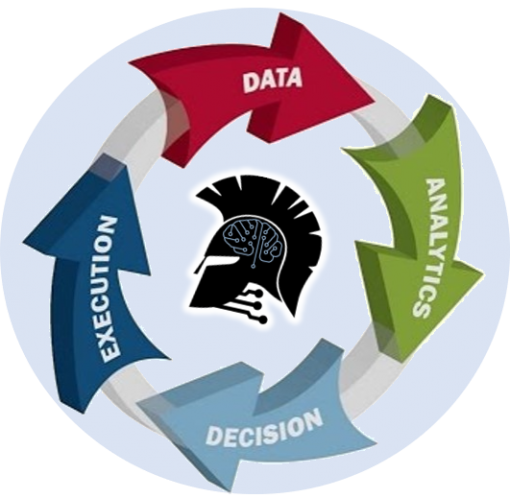
As decision-makers face increasing volumes of public and private information, the limiting factor is no longer access to data, but the ability to work with structured, decision-relevant datasets that reveal direction, momentum, and systemic risk.
Talosai helps organizations move beyond descriptive awareness toward anticipatory risk management, identifying where pressures are building, which domains are driving instability, and whether risk is accelerating or stabilizing. We bridge these knowledge gaps by pairing continuous measurement with written intelligence assessments that explain evolving conditions and their implications.
PRIVATE SECTOR

Talosai supports due diligence, exposure management, and scenario planning by continuously measuring how country stability is evolving—not by relying on lagging quarterly or annual assessments. The system helps manage risk about market entry, the recruitment of personnel, and how to respond to unexpected developments. Talosai key indicators can also be identified and tracked to monitor changes that could override the company’s underlying strategic assumptions or open up new strategic opportunities and perspectives. Talosai dashboards are accompanied by decision-grade, contextual analysis reports that help organizations interpret change, assess exposure, and anticipate second-order effects

PUBLIC SECTOR

Talosai enables early detection of systemic risk by monitoring domain convergence, momentum shifts, and signal persistence across governance, economy, society, defense, health, and psychological strain. It offers government clients country risk analyses for assessing and understanding geopolitical events to reduce exposure to events that can affect conditions within their governed area. Effective government strategies require identifying trend indicators, including information and media metrics, as well as leading and lagging economic indicators. Talosai also helps examine whether deeper trends – including the speed at which trends develop – can help to anticipate and explain the impact of changes in the economy, the political, social, and economic environment, or geopolitical events. This capability is reinforced through contextual intelligence analysis, enabling governments to move from descriptive monitoring to anticipatory planning.

Predictive Analysis for Situational Awareness and Threat Assessments

These analytical capabilities support decision-grade, contextual analysis delivered through accompanying intelligence reports, ensuring insights are usable, not just observable. The seamless incorporation of Large Language Models, Advanced Algorithms, and Big Data repositories such as Google Big Query, CIA World Factbook, Google News, Yahoo Finance, PR Newswire, Google Scholar, GDELT, Grants.Gov, ScienceOpen, Google Scholar, Core, BMC, and PubMed, enables researchers, policymakers, and international affairs professional to identify and act upon trends, and potential geopolitical problems of particular interest. All analytical outputs are supported by downloadable indicator datasets, allowing users to cross-reference Talosai signals with proprietary data, financial models, operational metrics, or scenario frameworks

$
0
Data Sets
0
Data Points