
USE CASES
Program Prioritization & Fragility Triage
How a development operations team can use Talosai to prioritize countries and sub-portfolios, detect multi-indicator deterioration early, and allocate limited resources based on measurable trajectory, evidence strength, and threshold probabilities.
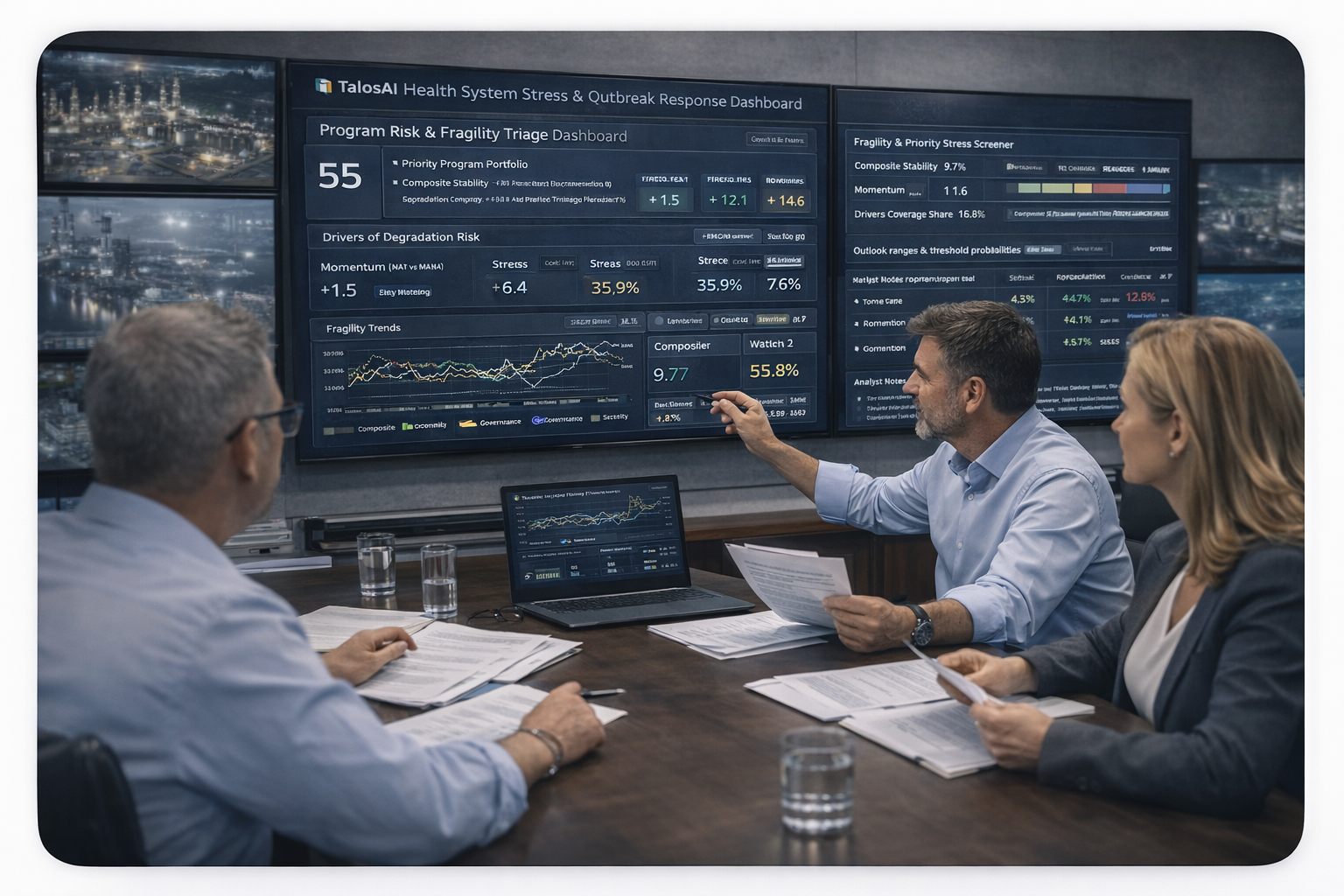
Talosai combines near real-time country stability dashboards with decision-grade, contextual analysis, so teams can see not just what is changing, but why it matters, how confident to be, and which decisions the signals should inform.
Governance (legitimacy, rule of law, service capacity narratives)
Economy (cost pressure, fiscal stress, livelihoods narratives)
Society (cohesion, violence, displacement, access constraints)
National Defense (conflict dynamics, escalation risk)
Health (system strain, outbreak and shock resilience)
Momentum (MA7 vs MA14)
Watch and Stress thresholds, including persistence signals
Evidence Strength and Reporting Volume diagnostics
Drivers of Change (Stress vs Resilience)
Domestic vs External lens, External Coverage Share, Tone Gap
Outlook ranges and threshold probabilities (30, 60, 90 days)
Decision-grade, contextual analysis that explains implications and decision relevance
User Profile
Context
A multi-country portfolio can span fragile and transition settings where conditions shift faster than most review cycles.
Funding and staffing constraints can require a disciplined approach to selecting priority countries for increased monitoring and surge support.
Several countries can show sporadic negative reporting related to food price stress, protests, security incidents, and governance controversy, while external media attention can surge around regional conflict dynamics.
Leadership can need to determine which locations are most likely to experience near-term deterioration, which risks are isolated versus systemic, and where program delivery and access are most likely to be disrupted.
Talosai supports this by continuously recalculating stability signals and pairing the dashboards with decision-grade, contextual analysis that clarifies what is changing, why it matters, and what decisions the signals should inform.
Challenge
- Allocating monitoring evenly rather than focusing on worsening trajectories
- Overreacting to isolated headlines without persistence and evidence support
- Missing systemic convergence, where multiple indicators weaken together
- Confusing external attention surges with domestic delivery risk
- Failing to translate signals and contextual interpretation into explicit program triggers and actions
Talosai in Practice
A development operations team can use Talosai to implement a structured fragility triage workflow across a portfolio.
The workflow can combine trajectory, acceleration, confidence diagnostics, and planning probabilities to rank countries for surge planning, enhanced monitoring, or routine review.
It can then pair the dashboard signals with decision-grade, contextual analysis that explains which indicators are moving, what is driving change, how confident to be, and which operational and program decisions should be prioritized.
Countries with multiple indicators in Watch can be treated as systemic risk candidates, supporting a higher monitoring cadence and earlier contingency planning, with the rationale documented in the accompanying contextual analysis.
These can be prioritized for rapid desk review and partner verification, then translated into a short decision note that clarifies what is accelerating, what could break, and what to watch next.
Low-evidence signals can be tagged for cautious interpretation and additional corroboration before major program changes, with confidence explicitly stated in the contextual analysis so leadership can calibrate action to signal quality.
This can help avoid misprioritizing countries where external narratives intensify without matching domestic delivery constraints, and it can improve decision utility by clarifying whether the operational risk is local access, reputational exposure, or both.
This can clarify whether delivery risk is driven by acute shocks, such as conflict flare ups, or structural erosion, such as sustained governance and economic fragility, then translate that mechanism into implications and options within the contextual analysis.
Link probability bands to pre-approved actions, including surge staffing, supply staging, partner support, and access contingency triggers, then document what each probability implies for decisions, timing, and resourcing in the contextual analysis.
Watch and Stress thresholds (triage categories) ·
Momentum (MA7 vs MA14) (early acceleration) ·
Evidence Strength and Reporting Volume (confidence) ·
Domestic vs External lens tools (attention attribution) ·
Drivers (Stress vs Resilience) (mechanism) ·
Outlook ranges and threshold probabilities (planning posture) ·
Decision-grade contextual analysis (implications, confidence, and decision linkage)
Decision Impact
- Monitoring resources can be concentrated on countries with deteriorating trajectories and strong evidence
- Country prioritization can become more defensible through thresholds, persistence, and explicit confidence statements
- Program adaptations can be triggered earlier, reducing delivery disruption and access surprises
- Portfolio leadership can align around a consistent triage language, decision ladder, and written rationale that explains why signals matter
Decisions can improve because they are anchored to measurable signals and reinforced by decision-grade, contextual analysis that clarifies implications and options.
Program disruption risk can decrease because adaptations are initiated earlier, with explicit triggers and contingency actions tied to probabilities rather than reactive headlines.
Key Takeaway
By combining multi-indicator stability signals, evidence diagnostics, outlook probabilities, and decision-grade, contextual analysis, teams can allocate scarce resources more effectively, explain why risks are forming, clarify confidence, and link signals to real decisions about monitoring posture, delivery adaptations, and contingency planning.