USE CASES

Case Study • Supply Chain

Supply-Chain Disruption & Logistics Resilience

How a global logistics team can use Talosai to detect early disruption signals, distinguish persistent risk from short-term noise, and pair near real-time dashboards with decision-grade, contextual analysis that explains what is changing, why it matters, and what routing, inventory, and vendor decisions it informs before delays become systemic.
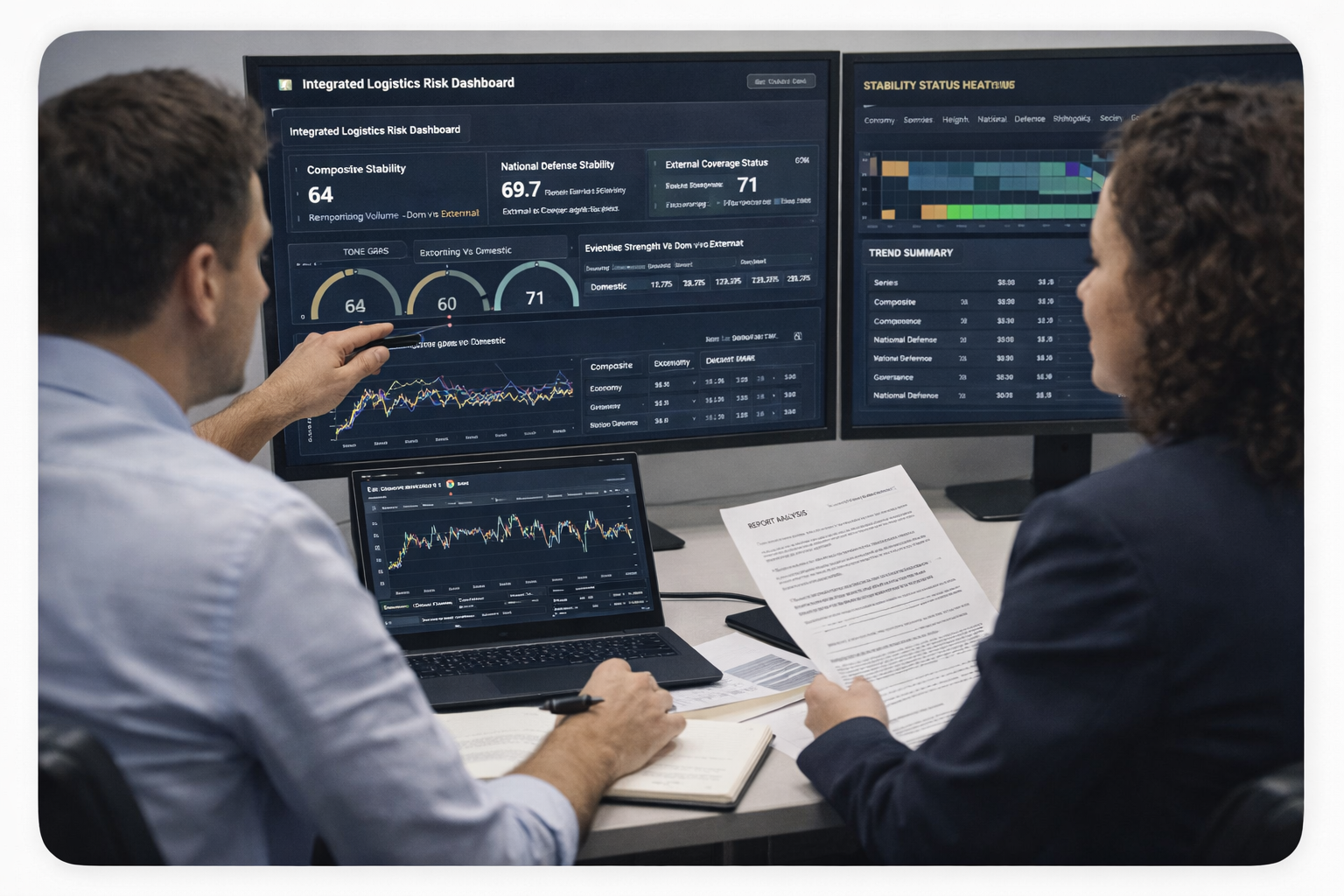
Talosai analysts reviewing stability and risk intelligence dashboards

At a glance
Primary users
Supply chain, procurement, logistics, and operations teams
Decision cycle
Weekly monitoring, daily escalation during disruption windows
Key Talosai features used
Composite and domain stability (0 to 100, country normalized)
Society and Economy signals (protests, strikes, cost pressure, labor unrest)
Governance signals (regulatory friction, legitimacy stress, policy volatility)
National Defense signals (security incidents, escalation risk)
Momentum (MA7 vs MA14)
Watch and Stress thresholds
Evidence Strength and Reporting Volume diagnostics
Domestic vs External lens, External Coverage Share, Tone Gap
Drivers of Change (Stress vs Resilience)
Outlook ranges and threshold probabilities (30, 60, 90 days)
Currency signals (FOREX integration), where available
Decision-grade, contextual analysis reports (what is changing, why it matters, what decisions it informs)

User Profile

Organization Type
Global manufacturer and distributor with regional hubs, time-sensitive inventory, and reliance on cross-border logistics corridors.
Role & Mandate
Protect continuity of supply by anticipating disruption risk, diversifying routes and vendors, and triggering mitigation actions before service levels degrade, supported by continuous measurement plus contextual analysis rather than reactive news monitoring.
Operating Constraints
Thin inventory buffers in peak seasons, limited visibility into local conditions, and high cost of late reaction once ports, trucking corridors, border processes, or labor markets destabilize.

Context

When a company relies on a country as a critical transit and procurement node, early warning matters more than retrospective reporting. A sequence of conditions can elevate concern, for example rising cost-of-living pressure, labor disputes in key transport sectors, periodic protests near logistics routes, or a tightening regulatory environment. External coverage can intensify, while internal stakeholders disagree on whether risk is transient or likely to persist. A logistics team can reduce this ambiguity by using a repeatable measurement and interpretation workflow that links public evidence to decision triggers.

Operational objective
Identify early warning signals that predict disruption risk, then translate those signals into decision-grade, contextual analysis that explains what is changing, why it matters, and what route changes, inventory buffers, and vendor diversification decisions it informs.

Challenge

Problem to solve
Determine whether the operating environment is entering a sustained disruption-risk stability pattern, identify which domains are driving that risk, and ensure mitigation decisions are proportional, timely, and justified by evidence rather than isolated headlines.
Common failure modes
  • Reacting too late, after congestion or labor stoppages are already widespread
  • Overreacting to short-lived protest coverage without persistence checks
  • Failing to detect spillover from economy into society and governance
  • Misreading external media surges as domestic operational risk
  • Taking costly rerouting actions without confidence checks

Talosai in Practice

A logistics team can use Talosai as a disruption-risk measurement and interpretation system, updated continuously and reviewed on a weekly cadence. The team can monitor domain stability signals tied to real logistics failure modes, validate confidence using evidence diagnostics, then pair dashboards with decision-grade, contextual analysis that explains what is changing, why it matters, and what actions it informs. This workflow supports disciplined triggers tied to Watch and Stress thresholds for the most logistics-relevant domains.

Step 1
Define logistics-relevant domains
Map logistics risk to Talosai stability domains: Society for protests and labor unrest, Economy for cost pressure and wage disputes, Governance for regulatory friction and border process volatility, and National Defense for security incidents affecting corridors. Document which decisions each domain can impact, for example carrier capacity, customs clearance, or supplier reliability.
Step 2
Triage with thresholds and clustering
Use Watch and Stress thresholds to identify whether any logistics-relevant domain is weakening into actionable territory. Look for clustering, such as Economy and Society weakening together, which can precede strikes, corridor disruptions, or service degradation. Pair this with a short analysis that clarifies why the clustering matters operationally.
Step 3
Detect acceleration early
Monitor Momentum (MA7 vs MA14) to detect near-term deterioration before it becomes visible in slower baselines. This can provide lead time for booking alternate capacity, staging inventory, and renegotiating delivery windows, with an analysis that states what decision timelines are at risk.
Step 4
Validate confidence with evidence
Use Evidence Strength and Reporting Volume to confirm persistence. When evidence is thin, treat sharp moves as lower confidence, then require corroboration across adjacent domains before triggering costly reroutes. The accompanying contextual analysis should explicitly state confidence and what would confirm or invalidate the signal.
Step 5
Separate domestic risk from external attention
Use the Domestic vs External lens, External Coverage Share, and Tone Gap to test whether signals are locally driven or primarily an external amplification cycle. This reduces false alarms that can occur when international attention spikes without an operational disruption signal, and it clarifies what decisions should change, if any.
Step 6
Explain mechanism through drivers
Use Drivers of Change (Stress vs Resilience) to determine whether risk is driven by rising acute stress, weakening buffers, or both. This supports targeted mitigation, for example short-term surge capacity versus longer-term supplier diversification, and it improves decision relevance beyond simple score movement.
Step 7
Plan with outlook probabilities
Use Outlook ranges and threshold probabilities to estimate likelihood of Watch or Stress in the next thirty to ninety days. Link these probabilities to triggers for safety stock, alternate routing, procurement lead-time adjustments, and customer promise windows, with a short analysis explaining why each trigger is proportional.
Step 8
Triangulate with currency signals, when available
Where configured, use Currency signals (FOREX integration) to check whether economic pressure narratives align with financial stress. If currency deterioration coincides with weakening Economy and Governance signals, treat it as a higher-confidence disruption posture and reflect that in the contextual analysis and decisions it informs.
Mapped dashboard features
Society, Economy, Governance, National Defense stability (logistics-relevant signals) · Composite stability (systemic context) · Momentum (MA7 vs MA14) (early warning) · Watch and Stress thresholds (action triggers) · Evidence Strength and Reporting Volume (confidence) · Domestic vs External lens, External Coverage Share, Tone Gap (attribution) · Drivers (Stress vs Resilience) (mechanism) · Outlook ranges and threshold probabilities (planning posture) · Currency signals (triangulation) · Decision-grade, contextual analysis (what is changing, why it matters, what decisions it informs)

Decision Impact

What can change in the decision
  • Move from reactive disruption response to measurable early-warning signals plus contextual interpretation
  • Trigger rerouting and capacity booking earlier, based on momentum and thresholds, not anecdotal escalation
  • Reduce unnecessary reroutes by requiring evidence strength confirmation and attribution checks
  • Improve cross-functional alignment by tying triggers to specific actions and decision owners
Outcome (illustrative)
Using this method, a company can implement a staged logistics posture, for example modest safety-stock increases when Economy and Society enter Watch with negative momentum, then alternate-routing readiness when Governance weakens with strong evidence support. Costs can decrease because actions are taken earlier and are proportional to measurable risk signals, with decision-grade analysis documenting what changed, why it matters, and what actions it informs.

Key Takeaway

Talosai helps supply chain teams convert public signals into measurable disruption triggers, then into decision-grade, contextual analysis.
By monitoring logistics-relevant domain signals, validating confidence with evidence diagnostics, and using thresholds plus outlook probabilities for planning, teams can improve resilience, reduce late-reaction costs, and maintain service levels under volatility, while clearly stating what is changing, why it matters, and what decisions it informs.